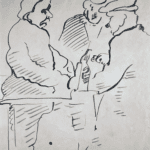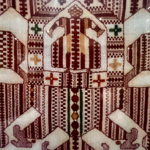
This exhibition explores themes of darkness, nighttime and shadows during the Socialist Realist period of Russian art. In the official art of Socialist Realism, ‘light’ was a universal metaphor for Soviet life that promised a radiant future to the people. Soviet artists were expected to produce artwork that was infused with energy and sunlight fit for exposure at state-supported and censored exhibitions. These scenes, lacking an identifiable source of light, display an experimental desire of Soviet artists that was never completely suppressed.
54 icons from the Yaroslavl Art Museum in the Main and Mezzanine Galleries
This exhibition features 54 extraordinary icons from the Yaroslavl Art Museum. The treasured, and once venerated icons on view were painted in the 17th and 18th centuries, considered “The Golden Age” of Yaroslavl’s cultural and commercial life. Separating the exquisite icons of Yaroslavl from others of the same period is the highly decorative quality, the free composition, the mass of architectural detail and lavishly decorated robes to tell a story through a common symbolic language.
The remarkable photographs of Sergei Prokudin-Gorskii offer a haunting glimpse into a lost world—
the Russian Empire on the eve of World War I and before the Bolshevik Revolution of 1917. With the support of Tsar Nicholas II, Prokudin-Gorskii traveled throughout the vast reaches of the Russian Empire, carefully documenting its people, architecture, landscape and industry. Using an innovative camera of his own design, Prokudin-Gorskii captured subjects in vivid color. TMORA presents 23 stunning images, borrowed from the Library of Congress, in a custom-designed light installation.
This exhibit of 54 fine art paintings traces the historical evolution and influence of impressionist painting from its roots in 19th century France to its successful transplantation in pre-Revolutionary Russia. Although impressionism was routinely suppressed by the Communist Party as a foreign-inspired and socially decadent art form for over six decades, Russian artists never abandoned their affection for and use of impressionist brush techniques and color pallet. Impressionism survived behind closed doors and re-emerged as a dynamic and beloved art form that is uniquely Russian.
Prints from the Zimmerli Museum and Rutgers University in the Lower Gallery
“Art was a controlled substance in Russia and the Communist-bloc countries of Eastern Europe during much of the Soviet era (1922-91). While government censors tried to restrict what artists painted or sculpted – especially anything with a religious or political theme – they largely ignored etchings, lithographs and other prints because they were considered minor art forms. A new show of 41 Soviet-era Estonian prints, on loan from Rutgers University, suggests that a lot of social commentary slipped under the official radar in those days. The Rutgers collection specializes in “nonconformist” art, meaning pieces that ignored or defied the official party line.” (Mary Abbe, Star Tribune)
61 paintings including 16 works from the State Russian Museum and the Tretyakov Galleryin the Main, Mezzanine, and Lower Galleries
Visitor’s Guide
Geli Mikhailovich Korzhev (1925 – ) is recognized by contemporary Russian art historians as one of the most influential painters of the second half of the 20th century; his work has influenced the style and subjects of two generations of post-WWII Russian artists. In collaboration with curators at the State Russian Museum (St. Petersburg) and the State Tretyakov Gallery (Moscow), TMORA will present an exclusive retrospective exhibition of 61 paintings that includes exceptional examples of Korzhev’s paintings from all segments of his remarkable career. 16 of the paintings are on loan to TMORA from the two largest Russian national museums. TMORA will dedicate its entire exhibition facility to this exhibition that represents the first solo exhibition for a single artist at the museum. This exhibition includes representative examples of works from every stage of Korzhev’s artistic life.
“The Museum of Russian Art has a fascinating show of large-scale photos of contemporary Russia by Andrew L. Moore of New York. Moore has a fabulous eye for design and detail, and seems to have had unparalleled access to everything from private apartments in St. Petersburg, to costume closets at the Kirov Ballet, to abandoned missile sites in remote villages. His stunning color photos… document a country undergoing dramatic economic and political changes.” (Mary Abbe, Star Tribune)
An exhibition of approximately 50 paintings featuring Russian landscape scenes and images of Soviet agriculture. The Virgin Lands project, communal farming and the social significance of agricultural development in Russia will be presented in a visual tour of all the varied geographical regions of the former Soviet Union.
The masterful oil paintings that are included in the Johnson Collection of Russian and Soviet art are only one dimension of the consummate artistic training and skills developed by generations of Russian artists. Works on paper represent another facet of Russian visual artistry. Russian art institutes provided rigorous training in drawing and composition through which individual artists became attracted to the media of graphite, charcoal, pastel and conte’ crayon. Alternatively, various artists became enamored by the fluid qualities provided by watercolor and gouache as well as by the spontaneous painting techniques required to effectively utilize these materials. The diversity that is inherent to 20th century Russian art is displayed throughout this exhibition of works on paper.